
What Do Emotions Look Like?
An Experiment Showing What Emotions Look Like
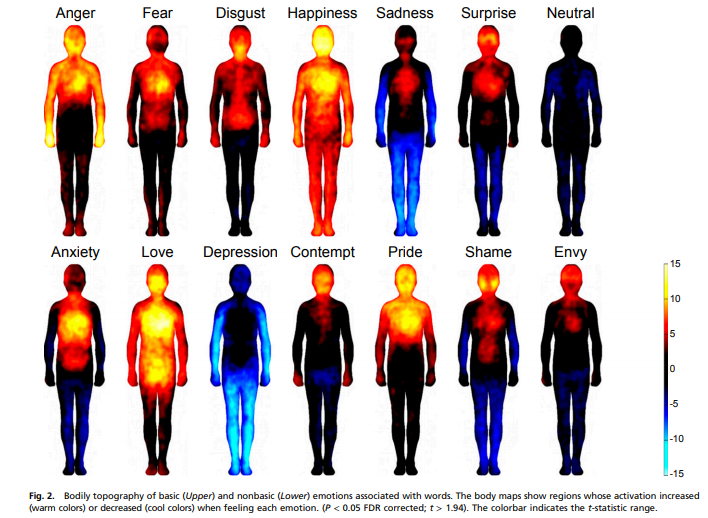
This study from 2013 aimed to see how emotions impact the body, so that researchers can better understand mood disorders such as depression and anxiety. And possibly find early biomarkers for emotional disorders.
To do this, scientists used 4 different experiments to see which ones impacted emotions the most and what that would look like in the physical body.
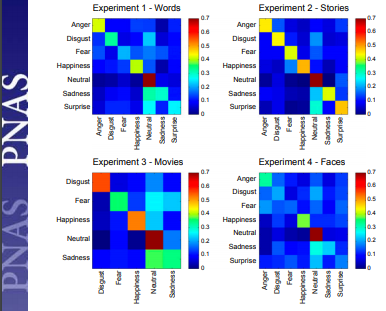
Experiment 1 used words to trigger emotional responses.
And experiment 2 used stories
Experiment 3 involved watching short movies
While experiment 4 had subjects look at basic facial expressions.
Emotions that were studied were: anger, fear, disgust, happiness, sadness, surprise, and a neutral emotional state.
“Prior work suggests that voluntary reproduction of physiological states associated with emotions, such as breathing patterns or facial expressions, induces subjective feelings of the corresponding emotion.
Similarly, voluntary production of facial expressions of emotions produces differential changes in physiological parameters such as heart rate, skin conductance, finger temperature, and muscle tension, depending on the generated expression.”
What Does This Mean?
This means that when the subjects are asked to think about events that bring feelings of sadness, happiness, fear, excitement, or any other emotion, their brain influences the physical body to match that emotional state.
Heart rate changes, skin conductance, temperature of the body, and muscle tension.
“The most basic emotions were associated with sensations of elevated activity in the upper chest area, likely corresponding to changes in breathing and heart rate.
Similarly, sensations in the head area were shared across all emotions, reflecting probably both physiological changes in the facial area and the felt changes in the contents of the mind triggered by the emotional events.”
What you perceive in the mind physically influences the state of your physical body.
“Sensations in the upper limbs were most prominent in approach-oriented emotions, anger and happiness, whereas sensations of decreased limb activity were a defining feature of sadness.”
Sadness, depression, has a defining feature of low feeling in the limbs. Low blood circulation.
“Sensations in the digestive system and around the throat region were mainly found
in disgust.”
“In contrast with all the other emotions, happiness was associated with enhanced sensations all over the body.”
Folks, all of these emotions were induced by watching videos, listening to words, listening to stories, and looking at facial expressions.
You must guard the doorway of your mind to make sure only the things you want are allowed in.
In the same token, everything outside of you that bothers you only touches what is already inside of you.
For Example:
If someone called you a purple people-eater, would you be offended by it? Probably not, because YOU KNOW it’s not true.
But when people say things that you feel offended by or resist, it’s usually because on some level, you believe it.
There is a wound there.
Maybe it was the phrasing of how it was said, or maybe it was the person who said it that reminded you of your father.
Who knows? These little programs are deeply in our subconscious mind, and they run the show. Until you begin to question yourself and your choices, seek to know yourself.
I’ve always thought that the greatest mystery to uncover is myself.
In Conclusion:
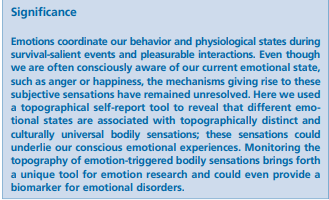
We understand others’ emotions by simulating them in our own bodies.
The emotions observed in the body maps were also in line with the brain imaging and behavioral studies that were found in previous studies (The emotion you feel in your brain correlates with the places in your body where the emotion is felt).
They found that emotional feelings are associated with discrete yet overlapping maps of bodily sensations.
It is at the core of the emotional experience.
The goal of the study was to help better understand mood disorders such as depression and anxiety, which are accompanied by altered emotional processing.
The way we perceive events determines our emotional response to them.
Our nervous system responds accordingly to how we perceive the event. And that influences the physical body. Just amazing!
To go in the dark with a light is to know the light. To know the dark, go dark. Go without sight, and find that the dark, too, blooms and sings, and is traveled by dark feet and dark wings.

Source: Bodily Maps of Emotions by Lauri Nummenmaa in the journal PNAS.


That would be really interesting to see, how that would look. Maybe neutral to a degree?
Great post. Thank you.
You’re welcome!